Understanding commonalities across systems enables students to develop a mindset for tackling challenges and solving problems.
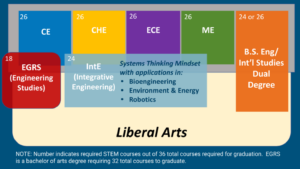 The Integrative Engineering program provides a systems-thinking approach so students can apply the principles of engineering design across disciplines, whether modeling electrical systems, constructing solar panels, building a robot, or designing a prosthetic. This systems-thinking mindset equips students with flexibility and versatility, preparing them to be agile thinkers with the ability to see meaningful connections and adapt to meet today’s highly complex technical challenges.
Along with a rigorous core of math and science classes, the program requires students to choose electives relevant to a focus in:
Bioengineering, Environment & Energy, or Robotics.
Integrative Engineering graduates are well-suited for challenging engineering and technical positions across the spectrum of engineering fields. Students study in emerging and cross-disciplinary environments, and are comfortable managing interdisciplinary issues and seeing connections within complex, big-picture settings. Depending on their focus area, Integrative Engineering graduates might consider careers in:
Students are equally well-qualified to pursue graduate study in their chosen focus area. Once the program achieves ABET accreditation in a few years, students will also be eligible to take the engineering licensure exam.